Getting started
How Chess Improves Maths and Concentration in School-Age Children
· 4 min read · The Mind Chess Academy
Almost every Indian parent we speak to asks the same question: will chess help my child in maths and studies? It is a fair question, and the honest answer has two parts. Chess clearly builds several habits that school rewards, such as sustained attention and careful step-by-step thinking. But chess is not a magic shortcut to higher marks. Here is what we see in classes, what research suggests, and how to get the most out of the game.
Concentration: practising focus every session
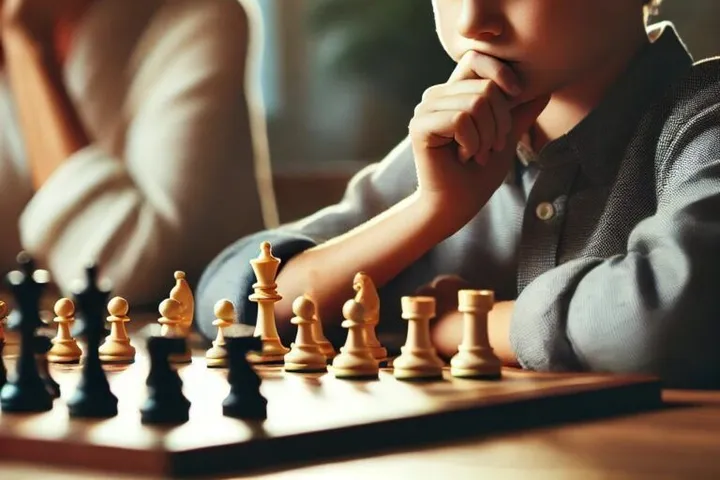
A chess game cannot be won while half-watching something else. To play a move well, a child must stay with a position, notice what changed after the opponent's move and resist the urge to play quickly. In a class of 45 to 60 minutes, children practise this kind of quiet attention many times over. Parents often tell us, after a few months, that their child sits longer over homework or reads a question more carefully before answering. This is the most consistent benefit we see.
Thinking in steps, the way maths problems work
Many maths errors come from rushing: skipping a step, not checking the answer, or not seeing what a question is really asking. Chess teaches the opposite habit. Before moving, a child learns to ask what the opponent threatens, what their own options are, and what happens after each option. This "if I do this, then that" thinking is the same structure used in word problems, geometry proofs and logical reasoning.
Pattern recognition and visualisation
Chess players learn to recognise recurring patterns, such as a fork, a pin or a typical checkmate. They also practise visualising moves in their head without touching the pieces. Pattern recognition helps in number sequences and mental arithmetic, and visualisation supports geometry and spatial reasoning.
Dealing with mistakes and pressure
Every chess game contains mistakes, and children quickly learn that a blunder is not the end of the world: you look for the best move from where you are now. That attitude carries into exams, where a child who panics after one wrong answer often loses marks on the next three.
What research does and does not show
It is worth being straightforward here. Several smaller studies in different countries have reported gains in maths-related skills among children who learned chess, and teachers often report better focus. However, larger controlled trials have not consistently found that chess lessons raise exam scores in maths or other subjects. A large trial in England, for example, found no measurable effect on pupils' test results. The sensible conclusion is that chess builds useful thinking habits, but those habits need to be supported by good teaching of the school subject itself.
How parents can help chess support school
- Link the two. After a game, ask "What did you check before you moved?" and use the same question when they do a maths problem.
- Keep a routine. Two or three focused chess sessions a week fit alongside homework better than long, irregular ones.
- Protect study time. Chess should add to a child's week, not crowd out sleep, exercise or school work, especially around exams.
- Praise process. Notice careful checking and patience, not only wins or high scores.
- Solve puzzles together. Short daily puzzles are a quick, enjoyable way to build focus; try our chess puzzles.
A simple weekly routine that works
- Two or three live classes, on fixed days, so the habit is predictable.
- Ten minutes of puzzles on one or two other days, ideally at the same time each day.
- One relaxed game with a parent or sibling at the weekend, with no pressure to win.
- A short monthly chat about what your child has learned, led by their questions rather than yours.
Families who stick to a routine like this usually see steadier progress than those who practise intensely for a week and then stop for a month.
Choosing the right kind of class
The benefits above depend on how chess is taught. Classes that are structured, small enough for the coach to see every child's thinking, and recorded for revision encourage careful thinking. Large noisy batches where children mostly play quick games build much less. You can read how our levels progress on the programs page, and the full fee for each level is on the pricing page.
If your child needs help with school maths itself, our sister academy The Mind Math Academy offers online maths classes for Classes 3 to 10.
Curious how chess could fit into your child's week? Book a free demo class and see how a live lesson trains attention and thinking.
Frequently asked questions
- Does chess improve maths marks in school?
- Chess builds habits that help with maths, such as careful step-by-step thinking and pattern recognition, but research has not consistently shown that it raises exam scores by itself. It works best alongside good teaching of the subject.
- How does chess improve concentration in children?
- A chess game requires sustained attention to the board, noticing changes and thinking before each move. Regular classes give children repeated practice at staying focused.
- How many chess classes a week are enough for a school-going child?
- Two or three classes a week, plus a little practice at home, usually fit alongside school and homework without overloading the child.
- At what age do the thinking benefits of chess begin?
- Children can start enjoying chess at four to six, and the planning and calculation skills develop more clearly from around seven or eight as they learn to think ahead.
- Can chess affect studies negatively?
- Only if it crowds out study, sleep or rest. Keeping a steady routine and reducing chess hours near exams helps balance both.
Want your child to learn with a coach?
Book a free 30-minute online demo class.